logo
Good price online

products details

Created with Pixso. Home Created with Pixso. Products Created with Pixso.
Thermoplastic Road Marking Paint
Created with Pixso. 10% Premixed Glass Beads Pavement Marking Customized Reflective Thermoplastic Road Marking Paint

10% Premixed Glass Beads Pavement Marking Customized Reflective Thermoplastic Road Marking Paint

Brand Name: HUA QUN
Model Number: HQ-147
MOQ: 1 ton
Price: Pending
Delivery Time: 3-7work days
Payment Terms: L/C, T/T, Western Union
Detail Information
Place of Origin:
China
Certification:
ISO9001
Features:
Quick
Maintenance:
Low Maintenance
Flexibility:
Flexible And Can Withstand Heavy Traffic
Function:
Road Safety
Keywords:
Reflective Paint
Color:
Red
Feature:
Quick Drying
Main Material:
C5 Pertroleum Resin
Packaging Details:
25kg per bag,40 bags per ton,25-28 tons per 1x20ft container
Supply Ability:
100 tons per day
Highlight:

Customized Reflective Thermoplastic Road Marking Paint

,

Customized Reflective Road Marking Paint

Product Description

10% Premixed Glass Beads Pavement Marking Customized Reflective Thermoplastic Road Marking Paint

        Description of Thermoplastic Road Marking Paint             


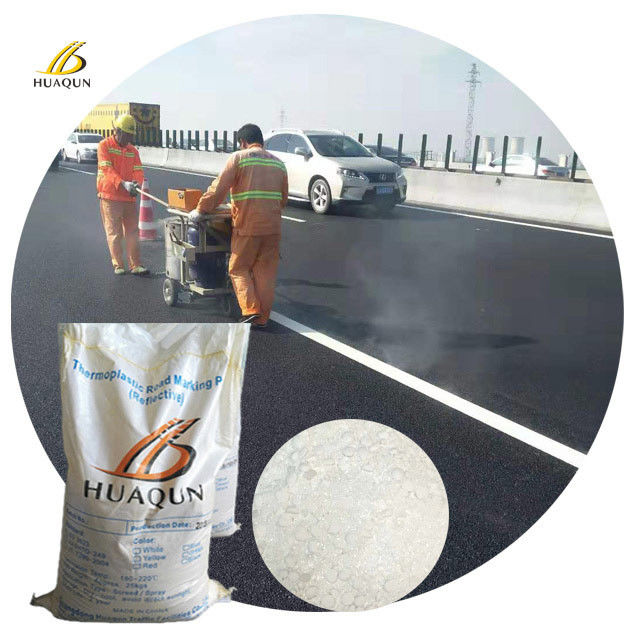
Thermoplastic paint is also known as hot melt marking paint.

It's a kind of paint that becomes fluid when heated and solidifies quickly when cooled. It's mainly used for road markings. The paint usually comes in solid form like pellets or blocks. When it's time to apply, it's heated to a molten state and then sprayed or spread onto the road surface. Once it cools down, it forms a durable, hard - wearing marking such as lane lines, crosswalks and other traffic - guiding symbols on the road.


      Does Thermoplasti Paint Adhere Well To Differient Surface?     


Thermoplastic paint generally has good adhesion to many surfaces.

On asphalt and concrete surfaces, it adheres well. When applied molten, it penetrates the pores and small crevices of these surfaces. As it cools and solidifies, a strong mechanical bond is formed. For example, on a well - prepared asphalt road, thermoplastic paint can create durable lane markings and traffic symbols that can withstand heavy traffic and weather conditions.

However, its adhesion to smooth and non - porous surfaces like some plastics or polished metals may not be as good. These surfaces don't provide the same opportunity for the paint to penetrate and form a mechanical bond. In such cases, surface preparation techniques such as roughening or using a primer may be needed to improve adhesion.


   Detailed Process of Hot Melt Road Line Paint Construction    


1. Prepare the Surface

  • Cleaning: Ensure the surface is free of dirt, grease, oil, dust, and loose debris.
  • Repair: Fix cracks or uneven areas to create a smooth surface.
  • Drying: The surface must be dry to ensure proper adhesion

10% Premixed Glass Beads Pavement Marking Customized Reflective Thermoplastic Road Marking Paint

2. Mark the Layout

  • Use chalk, tapes, or temporary markers to outline the areas to be painted (lines, symbols, or shapes).
  • Verify measurements against specifications or local standards.

10% Premixed Glass Beads Pavement Marking Customized Reflective Thermoplastic Road Marking Paint

3. Heat the Thermoplastic Paint

  • Use a melting kettle or thermoplastic preheater to melt the paint.
  • Heat to the recommended temperature, typically 180–220°C (356–428°F).
  • Avoid overheating, as it may degrade the paint and affect quality.
  • Stir continuously to ensure uniform consistency.

10% Premixed Glass Beads Pavement Marking Customized Reflective Thermoplastic Road Marking Paint


4. Primer Application (if required)

  • Apply a primer to the surface if recommended by the manufacturer.
  • This is especially needed for non-porous surfaces like concrete or asphalt.
  • Allow the primer to dry before applying the paint.

10% Premixed Glass Beads Pavement Marking Customized Reflective Thermoplastic Road Marking Paint

5. Apply the Paint

  • Screed Method: Use a screed box to create uniform thickness for road markings.
  • Spray Method: Use a spray machine for even application on large or irregular areas.
  • Extrusion Method: For thicker, raised markings.
  • Hand Application: For small areas or repairs, manually pour and spread the molten paint.
  • Preformed Thermoplastic: Lay pre-cut sheets or symbols on the surface and heat with a propane torch until adhered.

10% Premixed Glass Beads Pavement Marking Customized Reflective Thermoplastic Road Marking Paint

6. Check and Correct


After the coating is completed, check and correct the line shape, check the spread of glass beads, etc.

After confirming that it is correct, the construction site will be cleaned up.


After the line is dried and hardened, the relevant construction equipment can be transferred, the safety facilities can be dismantled, and the traffic can be opened.


10% Premixed Glass Beads Pavement Marking Customized Reflective Thermoplastic Road Marking Paint

10% Premixed Glass Beads Pavement Marking Customized Reflective Thermoplastic Road Marking Paint

10% Premixed Glass Beads Pavement Marking Customized Reflective Thermoplastic Road Marking Paint

10% Premixed Glass Beads Pavement Marking Customized Reflective Thermoplastic Road Marking Paint


                                                Customized Formula                                                             
Customized Formula Content(Customized range) Characteristics
C5 Resin 10%-22% Fluidity Toughness Hardness Adhesion
Titanium Dioxide 0.5-10% 0.5%-30%
Premixed glass beads 0%-30% Reflective after surface wear
Calcium Carbonate Sand 30%-80% Whiteness Wear-resistant Hardness
PE Wax 1%-1.5% Cold and heat resistant
EVA 0.5%-1% Crack resistance
Plasticizer 1%-1.5% Toughness


                         Advantages of Hot Melt Paint                                


- High Durability
It has excellent abrasion - resistance and can withstand repeated friction and pressure from vehicles and pedestrians. It can maintain a good appearance for a long time even in areas with heavy traffic. For example, on the lane markings of a highway, it's not easy to wear out even after a large number of vehicles have passed over it.
- Quick - drying
It dries fast and can be put into use shortly after application. This is very important in road construction as it can reduce the impact on traffic.


               How to Select Suitable Thermoplastic Paint                  


Choosing the right thermoplastic paint for road marking depends on several factors to ensure durability, visibility, and compliance with standards. Here are the key considerations:

1. Application Environment

  • Climate Conditions: Consider weather conditions such as temperature, humidity, and rainfall. Some paints are specifically formulated for extreme temperatures or high-moisture areas.
  • Traffic Volume: High-traffic areas require more durable paints with better wear resistance.
  • Surface Type: Ensure compatibility with the road surface material (e.g., asphalt or concrete).

2. Performance Requirements

  • Durability: Select a paint with high resistance to wear and tear, especially for heavy-traffic roads.
  • Reflectivity: Opt for paints that allow for the embedding of glass beads to enhance nighttime visibility.
  • Skid Resistance: For safety, especially in wet conditions, choose paints with anti-skid properties.

3. Compliance with Standards

  • Check if the paint complies with local regulations and standards for road markings, such as color, thickness, and reflectivity.

4. Application Method

  • Some paints are designed for specific application methods, such as spray, screed, or extrusion. Choose paint compatible with your equipment.

5. Color and Visibility

  • Select colors with high contrast to the road surface (e.g., white, yellow) and UV-stable pigments to prevent fading.

6. Drying Time

  • In high-traffic areas, choose a fast-drying formula to minimize disruption.

7. Cost Efficiency

  • Balance initial cost with long-term performance. High-quality thermoplastic paint might have a higher upfront cost but longer durability, reducing maintenance expenses.

8. Supplier Reliability

  • Purchase from reputable manufacturers or suppliers who provide quality assurance, technical support, and consistent product performance.

By considering these factors, you can choose thermoplastic paint that meets your project’s specific needs and ensures long-lasting, high-quality road markings.


                                    Company Profile                                          
10% Premixed Glass Beads Pavement Marking Customized Reflective Thermoplastic Road Marking Paint
 

10% Premixed Glass Beads Pavement Marking Customized Reflective Thermoplastic Road Marking Paint

10% Premixed Glass Beads Pavement Marking Customized Reflective Thermoplastic Road Marking Paint

Ratings & Review

Overall Rating

5.0
Based on 50 reviews for this supplier

Rating Snapshot

The following is the distribution of all ratings
5 stars
100%
4 stars
0%
3 stars
0%
2 stars
0%
1 stars
0%

All Reviews

A
A*x
Ghana Feb 26.2026
That is a good brand paint for my projects , i have bought this paint for many years
A
Abbas
Gambia Sep 26.2025
I like huaqun brand thermoplastic paint ,it really good , I will buy again
K
Krishna Bhad
Cameroon Dec 27.2024
Nice paint for road marking, I used it for 65 kilometre road